Rates data · Updated monthly
Australian SME Business Lending Rate Index
Indicative interest rates across our lender panel, tracked monthly against the RBA benchmark. Updated October 2026.
Unsecured business loans: 15–30% p.a. (indicative)
RBA benchmark, small business lending: 7.47% p.a. ▲ +0.01 pts vs prior month, as at August 2026
Index updated 8 October 2026 · Data last verified 11 October 2026
Business finance rates move with the cash rate, the lender, and your business's profile — and unlike home loans, they're rarely published in one place. The Avoir SME Business Lending Rate Indextracks the indicative rate ranges across our lender panel each month, benchmarked against the Reserve Bank's published business lending rate, so Australian SMEs (and the people who write about them) have a single, dated reference. Every figure is indicative, not an offer — your actual rate depends on the lender, the facility and your business.
The RBA benchmark averages 7.47% p.a. for small business, 6.21% p.a. for medium and 5.75% p.a. for large business as at August 2026— averages dominated by bank loans secured against property. This page is rebuilt from the RBA's source tables every month and is free to cite or embed with attribution.
Source: RBA Statistical Table F7, published 8 October 2026. Last verified 11 October 2026.
Current averages
Business lending rates, August 2026
Average rates on Australian business lending by business size, with the change on the prior month and on the same month a year earlier. Changes are in percentage points.
| Segment | Rate (% p.a.) | Monthly change | 12-month change |
|---|---|---|---|
| Small business, all outstanding loans | 7.47 | +0.01 | +0.57 |
| Small business, residentially secured | 6.99 | +0.01 | +0.66 |
| Small business, fixed-rate | 7.59 | +0.01 | +0.31 |
| Small business, variable-rate | 7.42 | +0.01 | +0.66 |
| Small business, new loans | 7.23 | −0.21 | +0.75 |
| Medium business, all outstanding loans | 6.21 | 0.00 | +0.66 |
| Large business, all outstanding loans | 5.75 | +0.01 | +0.62 |
Source: RBA Statistical Table F7, published 8 October 2026. Last verified 11 October 2026.
Trend
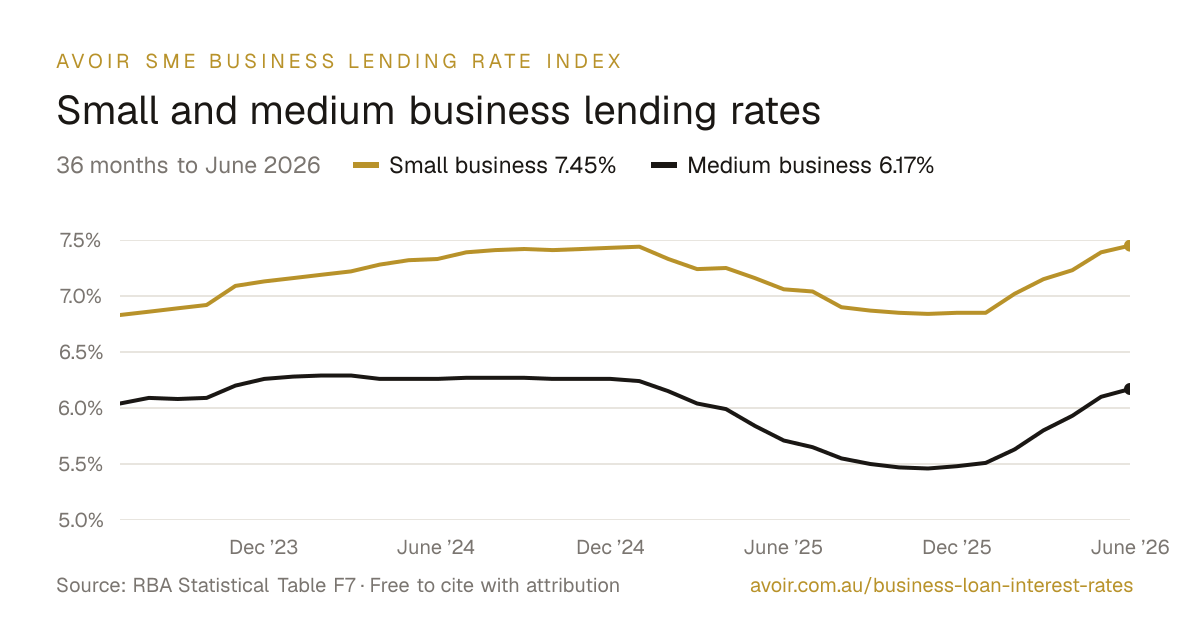
Small and medium business rates, last 36 months
Average rates on outstanding lending to small and medium businesses over the three years to August 2026. The gap between the two lines is the price of size: smaller borrowers pay more for the same money.
Source: RBA Statistical Table F7, published 8 October 2026. Last verified 11 October 2026.
This month in brief · August 2026
The average small business rate on outstanding bank loans was 7.47%, +0.01 points on the month. New small business loans were written at 7.23% (−0.21 points), and small businesses paid 1.72 points more than large businesses.
Full analysis in the Australian Business Lending Index →By facility type
Indicative rates by facility type
How the main SME facility types price relative to the RBA benchmark above, as at 11 October 2026. These are pricing bases, not offers — every facility is priced per application by the lender.
| Facility | Indicative pricing | Typical term | Notes |
|---|---|---|---|
| RBA benchmark — small business, all outstanding loans | 7.47% p.a. (August 2026) | — | Mostly bank lending secured against property; the reference point everything below prices against. |
| Unsecured business loan | Typically 15–30% p.a. (non-bank panel) | 3–36 months | Priced on cash flow with no property security; credit-impaired profiles sit at the upper end. |
| Secured / asset-backed loan | Between the RBA secured benchmark and the unsecured range | 1–7 years | Property or caveat security buys the rate down relative to unsecured. |
| Equipment finance (chattel mortgage) | Typically below unsecured — the asset itself is security | 1–7 years, matched to asset life | Write-off eligible when you own the asset; new assets price below used. |
| Business line of credit | Interest on the drawn balance only; some lenders add a facility fee | Revolving | Undrawn limits generally cost nothing, which suits an occasional buffer. |
| Business overdraft | Rate on the drawn amount, often plus a line fee on the full limit | Revolving | Mostly bank-provided; the line fee means an undrawn limit still costs. |
| Invoice finance | Fee on the advanced amount, not an annual rate | Settles when the invoice is paid | Secured by the receivables; advances typically 70–90% of invoice value. |
| Working capital loan | Fixed sum priced on cash flow — same basis as the unsecured range | 3–24 months | Fast funding for a defined, one-off need; funds often land within 24 hours. |
| Merchant cash advance | Factor-rate priced — a fixed total repayable, not an APR | Repaid from sales takings | Compare via the equivalent annual cost; early repayment usually saves nothing. |
Indicative ranges across our lender panel as at 11 October 2026. Indicative pricing bases, not offers. Numeric ranges are shown only where Avoir publishes and stands behind them; every facility is priced per application by the lender. The RBA benchmark in the table above is the verifiable reference point.
Reading the numbers
How this compares to the RBA benchmark
Read the averages for what they are. RBA Table F7 blends every business loan on bank books, and most of that lending is secured against property. A small business rate of 7.47% p.a. is what an established borrower with bricks-and-mortar security pays, after weeks of assessment and with the family home often sitting behind the facility. The residentially secured average of 6.99% p.a. makes the point: security buys the rate down.
Unsecured non-bank lending prices differently because the risk is different. The lender has no asset to recover if things go wrong, so it wears the full cash-flow risk of your business. Facilities through the non-bank panel we work with typically price between 15 and 30 per cent p.a. That is not a hidden margin; it is what taking property off the table costs. In exchange, decisions arrive in hours rather than weeks, assessment runs on bank statements rather than two years of financials, and no property is pledged.
Paying more is rational when the money earns more than it costs, or when the alternative is worse. A contractor bridging a certified progress claim, a retailer landing stock ahead of peak season, or an operator taking on a contract that needs upfront outlay can each do the sums: the margin on the opportunity against the cost of the facility. When the sums work and property security is either unavailable or not worth pledging, a dearer unsecured facility is the sensible trade. When they do not work, no rate is cheap enough. Our repayment calculator helps you run those numbers, and if the purchase is plant or vehicles, equipment finance secured against the asset itself usually prices below an unsecured loan, and the instant asset write-off can bring part of the cost back at tax time.
Market size
How much Australian businesses borrow
$209.8 billion
Small business credit outstanding, August 2026
$589.7 billion
Medium business credit outstanding, August 2026
Australian small businesses owed $209.8 billion to lenders as at August 2026, and medium businesses $589.7 billion, according to RBA Statistical Table D14. A year earlier those figures were $192.9 billion and $538.9 billion. Business borrowing is growing, and most of it still runs through the banks on secured terms.
Source: RBA Statistical Table D14, published 8 October 2026. Last verified 11 October 2026.
Methodology
How the index is calculated
The Avoir SME Business Lending Rate Index combines two layers. The benchmark layer is drawn programmatically from RBA statistical tables F7 (business lending rates) and D14 (business credit outstanding), which the RBA compiles from data reported to APRA under the Economic and Financial Statistics collection. The refresh runs after each monthly RBA release; nothing is estimated or interpolated, and if a series fails validation the page keeps serving the last verified data.
The facility-type layer describes how our non-bank lender panel prices each facility relative to that benchmark. Ranges are indicative of what businesses meeting each facility's criteria are being quoted — not offers, not averages of settled loans, and not a guarantee of any rate. Numeric ranges are shown only where Avoir publishes and stands behind them; otherwise the pricing basis is described rather than invented, because lenders quote each facility per application. The "last updated" date on this page is bound to the underlying data timestamp (11 October 2026). See our data sources page for every dataset behind this site.
Free to use with attribution
Cite this index
Journalists, researchers and publishers are welcome to quote, chart or republish this data. Attribute it to the Avoir SME Business Lending Rate Index with a link to this page — the citation, live-updating embed and raw CSV below are ready to use.
Citation
Source: Avoir SME Business Lending Rate Index, August 2026, https://www.avoir.com.au/business-loan-interest-rates
Embed the chart
Paste this snippet to embed the live chart on your site. It updates automatically each month and includes the attribution link.
<iframe src="https://www.avoir.com.au/embed/lending-rate-index" width="600" height="400" style="border:0" title="Avoir SME Business Lending Rate Index" loading="lazy"></iframe>
<p><a href="https://www.avoir.com.au/business-loan-interest-rates">Source: Avoir SME Business Lending Rate Index</a></p>
Download the data
FAQ
Rate questions, answered
What is the average business loan interest rate in Australia?
It depends on the facility. As at October 2026, indicative unsecured business loan rates on our panel range 15–30% p.a., while secured and equipment finance sits lower. The RBA's benchmark for outstanding small business lending is 7.47% p.a. as at August 2026 (Statistical Table F7, published 8 October 2026), with medium business at 6.21% p.a. and large business at 5.75% p.a. Rates are indicative, not offers.
Why are non-bank business loan rates higher than bank rates?
Non-bank and specialist lenders price for speed, flexibility and lending without property security — decisions in hours rather than weeks, and cash-flow-based assessment rather than requiring collateral. The RBA averages mostly reflect bank loans backed by property, where the lender can sell the security if the borrower defaults. An unsecured lender carries the full cash-flow risk of the business, which is why unsecured facilities typically run 15 to 30 per cent p.a. depending on trading history, revenue, and credit profile.
What rate is my business eligible to apply for?
It depends on your trading history, revenue, credit file, industry, and whether you offer security. A business with two or more years of trading and consistent revenue is eligible to apply for the sharper end of the unsecured range. Newer businesses and those with credit impairments pay more. The only way to know your actual rate is to apply and receive offers, which through Avoir starts with a soft credit check that leaves your score untouched.
How are business loan interest rates set?
Lenders start from their own cost of funds, which moves with the RBA cash rate and wholesale funding markets, then add a margin for risk and cost of service. The margin is where your business comes in: security offered, trading history, revenue consistency, industry, and credit profile all move it. That is why property-secured bank lending sits near the RBA averages on this page while unsecured non-bank facilities price well above them — the lender is carrying more risk with no asset behind the loan.
How often is this index updated?
Monthly, when the RBA releases updated lending-rate data. The RBA publishes Statistical Table F7 in the first week of each month and our data refresh runs automatically after each release. Each update is dated at the top of the page and in the underlying dataset; the figures here come from the RBA publication of 8 October 2026 and were last verified on 11 October 2026.
Can I cite or republish this data?
Yes, it's free to use with attribution. Quote the figures, embed the live chart, or download the CSV — just credit the Avoir SME Business Lending Rate Index with a link to this page. The underlying benchmark series is RBA Statistical Table F7, and our methodology section explains exactly how the index is put together.
Is a higher business loan rate ever worth it?
The question isn't just what rate you pay — it's what the capital enables. A $50,000 loan at 25% p.a. to bridge a cash flow gap before a major contract payment can be rational if the alternative is being unable to fulfil that contract. Model the cost of the loan against the opportunity it creates or the problem it solves.

By James Baker · Founder, Avoir
Founder of Avoir and a commercial finance specialist focused on asset and equipment finance for Australian transport, civil and construction businesses.
Last reviewed: 11 October 2026
Sources: RBA Statistical Tables F7 (business lending rates) and D14 (business credit outstanding), compiled from APRA data; Avoir lender panel published criteria (see data sources).
General information only, not financial advice, and not an offer of credit. Figures are indicative averages and pricing bases, not rates available to any particular borrower — every facility is priced per application by the lender. Verify current RBA figures at the source before relying on them.
Your actual rate
Averages are context. Offers are answers.
Two minutes to apply, a soft credit check only, and a specialist in touch within two hours with rates priced to your business rather than the national average.
NO COLLATERAL
SOFT CHECK ONLY
2 MIN APPLICATION